Part 11 of 12 in the Try It Yourself series — practical AI guidance for parents at blog.parentsguidetoai.ca
Section 9 of the parent's guide includes a Family AI Agreement — a template that families can use to set shared expectations about how AI is used at home. We've been building toward this conversation for ten posts.
If you've followed this series, you've tried AI yourself. You've spotted a mistake. You've checked privacy settings. You've thought about what's different between school AI and home AI. You've watched a deepfake example. You know what bias looks like in an AI response.
That preparation matters. When you sit down with your child to write an agreement, you're not reading from a pamphlet. You're having a conversation with someone who has experience.
Why agreements work better than rules
Rules are handed down. Agreements are made together.
That's not a small difference. When a child participates in setting expectations — when they understand the reasoning behind each rule and had some say in its form — they are more likely to take those expectations seriously. They are also more likely to come to you when something doesn't fit the agreement, because they were part of making it.
The parent's guide makes this point directly:
"The goal is not a signed document. The goal is a shared understanding."
The agreement is a record of the conversation you had, not a contract you hand to your child to sign.
What your agreement should cover
The parent's guide suggests five areas to address. Here's what each one means and what the conversation might look like.
1. Learning and studying
What role, if any, does AI play in homework? Is your child allowed to use AI to understand a topic, but not to write their essay? Can they use it to check their work but not to do it for them?
This is the area most parents think about first, and it's where the conversation with your child is most likely to surface honest disagreement. Your child may have a different view of what counts as "using AI for homework" than you do. That tension is worth surfacing directly.
Discussion question: "When do you think it's okay to use AI for school, and when isn't it?"
2. Academic integrity
Related to the above, but specific to what counts as your child's own work. This is also an opportunity to talk about what the school expects — which may be different from what you expect, and different again from what your child's friends are doing.
Discussion question: "What does your school say about using AI for assignments? Do you think that's fair?"
3. Privacy
Revisit the privacy checklist from Post 4. What does your family agree should never go into an AI tool? This is an area where the agreement can be explicit: no real names of classmates, no home address, no financial information.
Discussion question: "What would you never type into AI? Why?"
4. Harmful uses
This covers the more serious territory from Post 9: generating content that could harm someone, creating fake images of real people, using AI to deceive or manipulate. It's worth naming these explicitly in the agreement, even if they feel unlikely.
Discussion question: "What kinds of things do you think AI shouldn't be used for? What would you do if a friend showed you something they'd made with AI that felt wrong?"
5. Honesty
If AI was used for something, is your child expected to say so? This varies by context — school assignments often have specific disclosure requirements, but what about at home? The agreement can include a simple norm: "If AI helped you with something, you can tell us."
Discussion question: "If you used AI to help write something, would you want people to know? Why or why not?"
How to run the conversation
A few practical suggestions for making the conversation go better.
Go in with questions, not a lecture. Start by asking your child what they know, what they think, and what they already do. You may be surprised — and it gives them the experience of being heard before the expectations are set.
Share what you've experienced. This series gave you hands-on experience. Use it. "I tried this thing and found out AI got it wrong" is a more effective conversation starter than "AI can make mistakes."
Acknowledge what you don't know. You don't need to have answers to every question your child raises. "I don't know, let's look that up" is a fine answer — and modeling that kind of intellectual honesty is part of the point.
Write it down. Even a short list on a piece of paper or a note on the fridge counts. Writing it makes it real and gives you something to refer to later.
A suggested template
The parent's guide includes a simple template in Section 9, but here is an easy to use template you can use to get started!
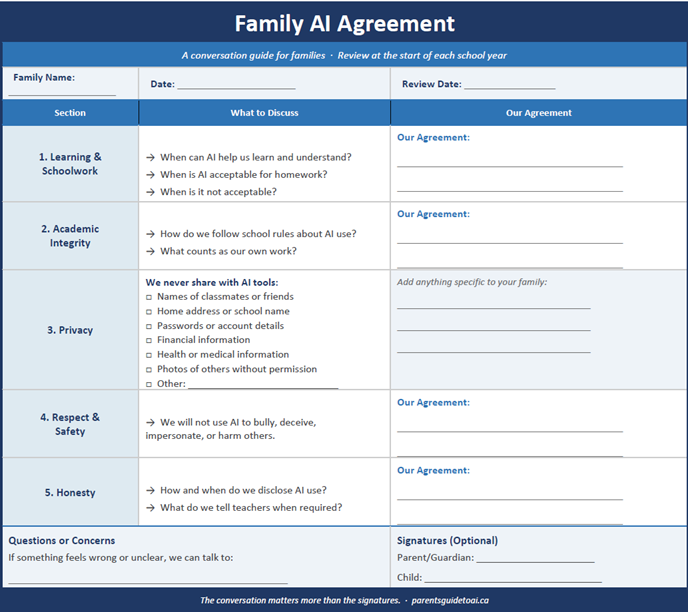
Download the Family AI Agreement template Microsoft Word | PDF — a one-page fillable document you can print or complete on screen.
The short version:
- Agreements made together work better than rules handed down from above.
- Five areas to cover: learning and studying, academic integrity, privacy, harmful uses, and honesty.
- Go in with questions, not a lecture — your child's perspective matters.
- Write it down, even briefly. A note on the fridge is enough.
- Review it at the start of each school year, since AI and school policies will both change.
One post left. The final post in this series is about how to stay current as AI keeps changing — five resources to bookmark, and the habits that matter more than any specific tool.
Schedule 20 minutes: Pick a time this week to have the family AI conversation. You don't need to cover everything in one sitting. Start with one area — privacy or learning — and build from there.